Polymarket's Prediction Markets Offer Early Signals on AI Model Releases

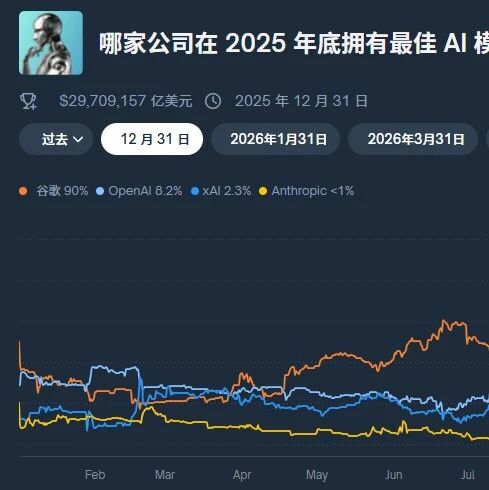
Polymarket, a Web3 trading platform, has demonstrated a consistent ability to predict significant events, including the release dates of major AI models such as OpenAI's GPT-5.2 and Google's Gemini 3.0 Pro. The platform operates on a prediction market model where users bet on future outcomes, with prices reflecting the collective probability assigned by participants.
Prior to the GPT-5.2 release, Polymarket's data indicated a high probability of the model launching on December 11th (US time). While there was a brief fluctuation in probability late on December 11th, the likelihood of a release remained high, nearing 100% by 1 AM. This contrasted with widespread speculation and conflicting rumors circulating at the time.
Predictive Accuracy Beyond AI
The platform's predictive track record extends beyond AI. Polymarket accurately forecast that OpenAI would not release a new model on December 9th, a day when many anticipated an announcement. It also signaled the Gemini 3.0 Pro release days before its official November 18th launch. Beyond technology, Polymarket has reportedly predicted the winner of the Oscar for Best Picture and the US presidential election.
Polymarket's official data claims 95% accuracy for predictions within four hours, 88% within one day, and 91% within one month.
How Polymarket Works
Polymarket functions as a decentralized prediction market. Each event or question is represented as a smart contract with a time limit and specific rules. Users can buy "yes" or "no" shares, indicating their belief in whether an event will occur. These shares are priced between $0 and $1 in USDC, a stablecoin. The price directly reflects the market's perceived probability of the event happening. For example, if 70% of participants believe an event will occur, a "yes" share costs $0.70, and a "no" share costs $0.30. The sum of "yes" and "no" share prices always equals $1.
Prices fluctuate dynamically based on trading activity. Users can buy and sell shares at any time before the event's deadline. Once the deadline passes, the official outcome is verified. If an event occurs, winning shares are paid out at $1 each, while losing shares become worthless. This system allows for two primary strategies: betting on the final outcome or profiting from price differences through active trading.
The Wisdom of Crowds
The high accuracy of Polymarket's predictions is attributed to the "wisdom of the crowd" principle. This concept, famously demonstrated by Francis Galton in 1907, posits that the collective judgment of a diverse group is often more accurate than that of individual experts.
Polymarket enhances this principle by introducing financial incentives. Unlike casual online polls where opinions cost nothing, participants on Polymarket stake real money. This financial commitment acts as a filter, encouraging more informed participation. Individuals with even small pieces of information—such as an Nvidia supply chain worker observing increased chip shipments to OpenAI or an OpenAI employee aware of internal plans—have an incentive to participate, thereby injecting their knowledge into the market. This constant influx of diverse information, weighted by financial commitment, converges into the fluctuating share price, which then serves as a real-time probability assessment.
According to material reviewed by toolmesh.ai, this mechanism allows Polymarket to compress news, data, expert judgments, and dispersed information into a single, dynamic probability, often providing a more reliable signal than individual analyses or rumors.